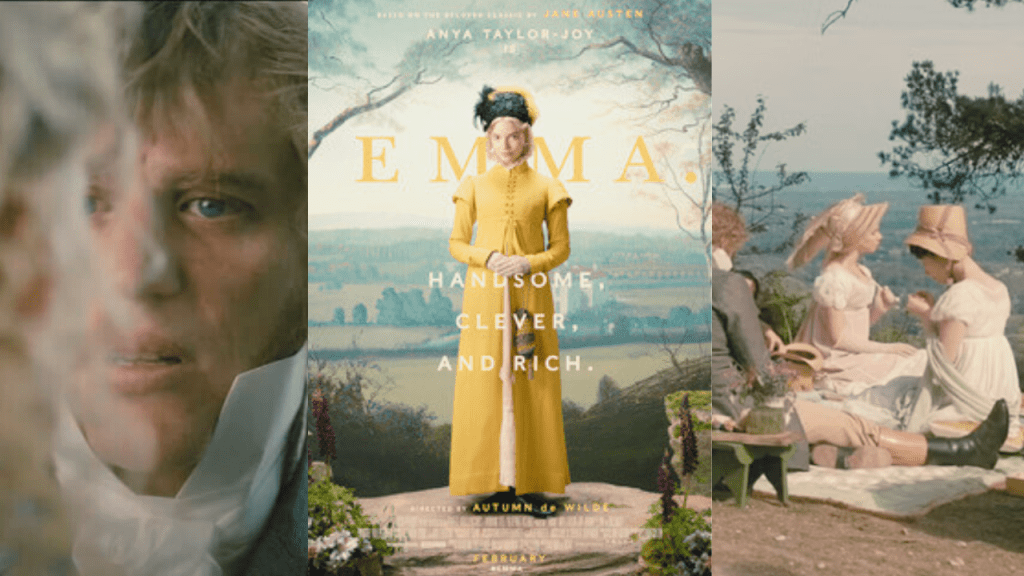
The 2020 adaptation of Emma, directed by Autumn de Wilde brings Austen’s novel to light through visual choices highlighting the beautiful and sublime. In A Philosophical Enquiry into the Origin of Our Ideas of the Sublime and the Beautiful, Burke defines the beautiful as “quality or those qualities in bodies by which they cause love, or some passion similar to it,” (p.128) While the sublime—a concept attributed to the ancient Greek philosopher Longinus that Burke builds upon—excites “ideas of pain, and danger,” which “operates in a manner analogous to terror,” (p.86). The film at first glance leans heavily into Burke’s category of the beautiful with the pastel color palette, symmetrical compositions, and meticulous costuming reinforcing refinement and control. However, de Wild strategically disrupts this by introducing moments of the sublime—most notably the nosebleed scene—expressing emotional intensity. This presentation will explore how Emma (2020), analyzed through Burke’s theory of aesthetics, uses the transitions between beauty and sublimity to evoke a shifting emotional response, Burke describes as a means of strengthening the narrative and visualization of the film.
Works Cited
Burke, Edmund. A Philosophical Enquiry into the Origins of the Sublime and Beautiful: And Other Pre-Revolutionary Writings. Edited by David Womersley. Revised edition. London New York Camberwell, Victoria Toronto New Delhi Auckland Rosebank: Penguin Classics, 1999.




 Tiffany Franchesca Cruz
Leave a comment